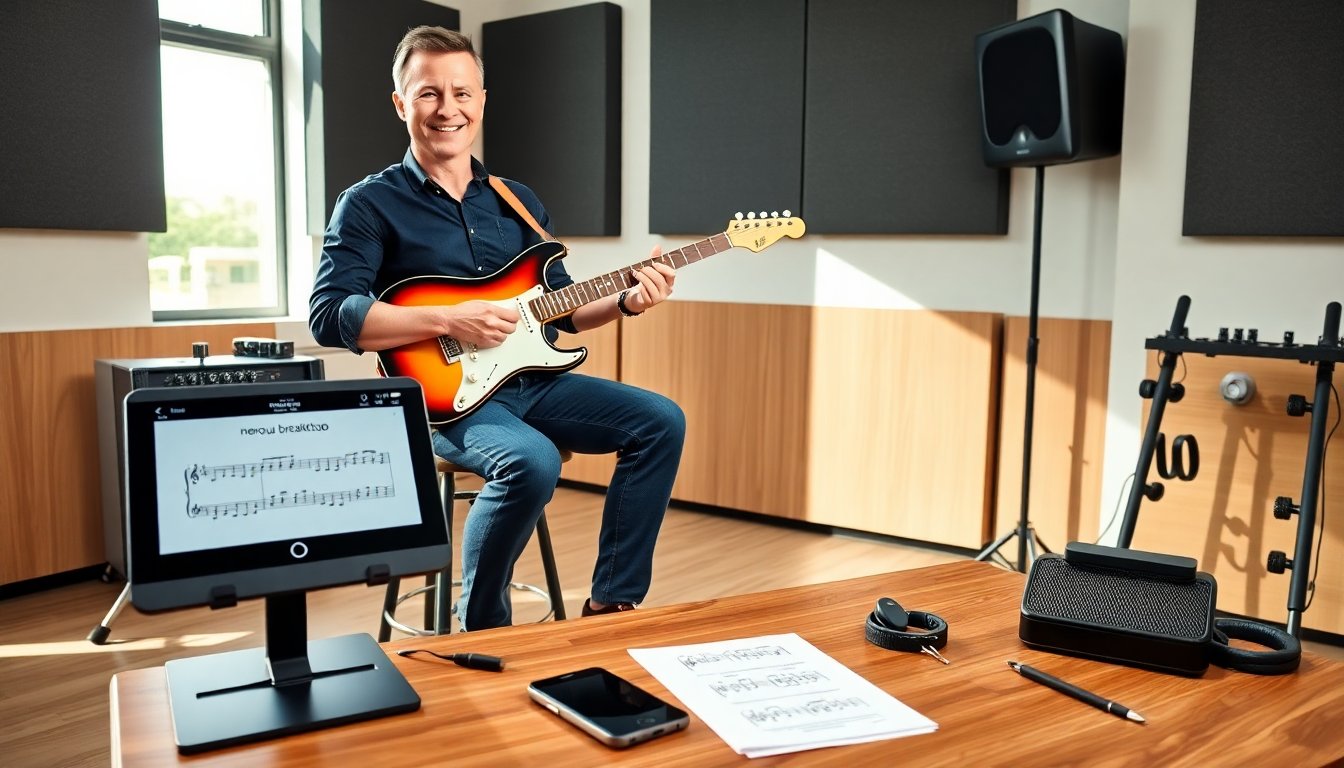
nervous breakdown tab appears here to help players learn the song fast. The guide names the guitar parts, shows clear tab, and lists practice steps. It keeps language simple so a player reads and applies the tab without guesswork.
Key Takeaways
- The nervous breakdown tab provides a clear, labeled electric guitar arrangement focusing on fast 4/4 distorted power chords for easy learning.
- Players should tune their guitar to standard tuning (E A D G B E) and use an amp with moderate overdrive and a metronome set between 180–200 BPM.
- Start practicing the main riff slowly with palm muting, gradually increasing speed by 5–10 BPM increments until reaching the target tempo.
- Practice the verse, bridge, and solo sections separately, looping the bridge as you learn the solo to build smooth transitions in the nervous breakdown tab.
- Use official songbooks and reputable tab websites for accurate tabs, and supplement practice with backing tracks and metronome or loop station apps.
- Include “nervous breakdown tab” plus the artist’s name when searching online to find the most relevant and accurate version.
Song Overview: Which “Nervous Breakdown” Is This?
This guide covers the classic punk-era “Nervous Breakdown” riff. It focuses on the electric-guitar arrangement that most bands play live. The tab here reflects a fast 4/4 version with distorted power chords and concise lead fills. The guide labels each section so a player can skip to riff, verse, or solo. The term nervous breakdown tab appears throughout to keep references consistent and searchable.
Essential Tools And Tunings Before You Start
The player needs a guitar, amp, a pick, and a metronome. The guitar should be in standard tuning (E A D G B E). The amp should use overdrive with moderate gain and a tight low end. The pick should be medium to heavy for attack. The player should set tempo to 180–200 BPM for the original feel and use a metronome when learning the nervous breakdown tab.
Main Riff Tab With Beat-By-Beat Notes
The main riff uses open power chords and single-note runs. The tab below shows the core pattern. The player should play with palm muting on the low strings for punch. Play slowly first, then raise tempo in 5–10 BPM steps until the nervous breakdown tab matches the target speed.
e
|—————-|—————-|
B
|—————-|—————-|
G
|—————-|—————-|
D
|–2-2-2-2-4-4-4-|–5-5-5-5-7-7-7–|
A
|–2-2-2-2-4-4-4-|–5-5-5-5-7-7-7–|
E
|–0-0-0-0-2-2-2-|–3-3-3-3-5-5-5–|
Play one measure at a time. Count “1-and-2-and-3-and-4-and.” Keep attack even and consistent. Repeat the line four times to form the intro and verse.
Verse, Bridge, And Solo: Full Section Tabs
The verse repeats the main riff with slight vocal pauses. The bridge shifts to higher power chords and adds a small chromatic walk. The solo sits over the bridge and uses minor pentatonic phrases. The tab lines below show the verse, bridge, and solo in sequence so a player can practice each section.
Verse (same as main riff, 4x)
Bridge:
e
|—————-|—————-|
B
|—————-|—————-|
G
|–7-7-6-6-5-5—|–4-4-5-5-7-7—|
D
|–7-7-6-6-5-5—|–4-4-5-5-7-7—|
A
|–5-5-4-4-3-3—|–2-2-3-3-5-5—|
E
|—————-|—————-|
Solo (short phrase):
e
|–10-9-7-9-10-|–7-9-10-12-10-9-|
B
|————–|——————|
G
|————–|——————|
D
|————–|——————|
A
|————–|——————|
E
|————–|——————|
The player should loop the bridge while practicing the solo. The player should not rush the nervous breakdown tab when linking sections.
Where To Find Accurate Tabs, Backing Tracks, And Practice Resources
The player should use official songbooks and reputable tab sites for verified tab. The player should check multiple sources and compare tabs to recordings. Backing tracks appear on major streaming sites and on video platforms. The player should download a metronome app and a loop station app for slow practice. When searching, include the phrase nervous breakdown tab plus the artist name to find the right version.