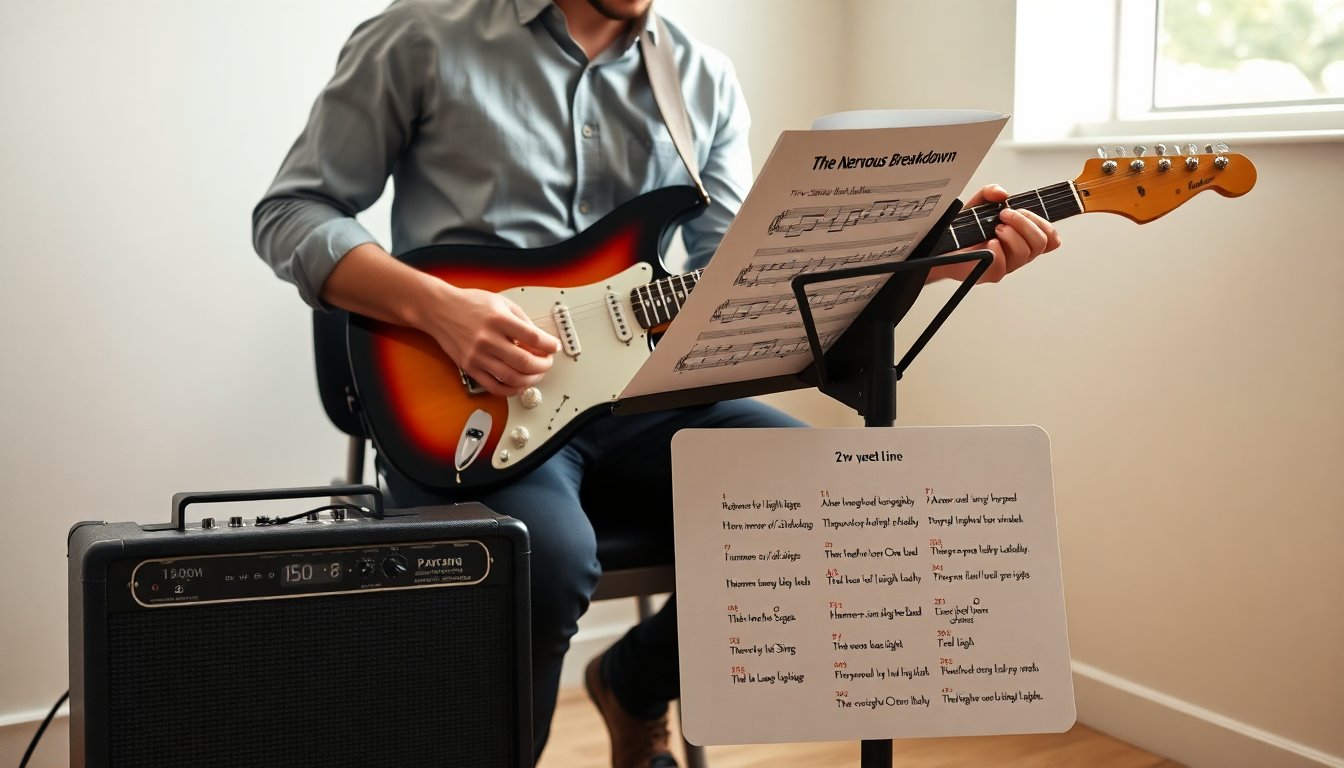
The nervous breakdown tab appears in the first line and sets the lesson focus. This guide gives a clear path to learn the nervous breakdown tab. It shows tempo, tone, structure, techniques, the solo, and a two‑week plan. The reader gets short exercises and concrete steps. The text keeps each sentence simple. The instructions suit self‑taught players and teachers who want a compact plan.
Key Takeaways
- The nervous breakdown tab features a fast blues-rock groove best practiced with a metronome setting starting at 70–85 BPM and moving up to 150–170 BPM for accuracy and feel.
- Players should focus on mastering core techniques such as alternate picking, palm muting, pull-offs, and precise bends, supported by targeted warmup exercises for control and tone.
- Understanding the song structure—intro, verse, chorus, bridge, and solo—and navigating repeats and phrasing helps maintain timing and flow while playing the tab.
- Practicing the main riff slowly with attention to timing, attack, and palm mute placement is essential before advancing to the solo, which should be learned phrase-by-phrase at reduced tempo.
- A detailed two-week practice plan balancing accuracy, consistency, speed, and recording progress offers a structured approach to efficiently learn the nervous breakdown tab.
- Setting tone with a dry tube amp and small overdrive, using neck or middle pickups, and adjusting string gauge/action improve bending comfort and sound authenticity.
Song Overview, Tempo And Tone Setup
The nervous breakdown tab reflects a fast blues‑rock groove. Players should set the metronome to 150–170 BPM for practice. They should start at 70–85 BPM for accuracy. The song uses a dry tube amp sound with a mid boost and light reverb. Players can use a small overdrive pedal and the neck or middle pickup for warmth. They should check string gauge and action for bending comfort. Tuning must match the song: most versions use standard tuning. When they dial tone, they should aim for clarity on single notes and grit on chords.
Reading The Tab: Structure, Sections, And How To Navigate Repeats
The nervous breakdown tab contains an intro, verse, riff-based chorus, bridge, and solo section. Players should mark repeat signs and codas on the page. They should read bars left to right and follow section labels. When a repeat appears, they should count measures aloud before restarting. They should note pickup notes and syncopated rests. The tab often shows hammer-ons and slides as single symbols. Players should map the song structure with a quick outline: Intro (4 bars), Verse (8 bars), Chorus (8 bars), Bridge (4 bars), Solo (16 bars).
Main Riff Breakdown: Note‑For‑Note With Timing Tips
The main riff drives the song. Players should play the riff slowly and count eighth notes. They should focus on attack and palm mute placement. The riff uses open strings and fretted notes on the low E and A strings. They should finger the fretted notes with the index and middle for economy. For timing, they should play the first two beats clean and add subtle swing to beats three and four. They should practice the riff in sets of four measures and add a metronome click on beats two and four.
Core Techniques You Need And Focused Warmup Exercises
Players need alternate picking, palm muting, pull‑offs, and precise bends. They should spend ten minutes on chromatic warmups. A simple exercise: play frets 1–4 on each string with strict alternate picking. They should do slow bends to target pitch and hold for three seconds. For pull‑offs, they should practice two‑note patterns across the fretboard. For palm muting, they should mute lightly near the bridge and vary pressure for tone control. They should add dynamic taps and slight vibrato to match the recording.
Playing The Solo: Phrase‑By‑Phrase Approach
The solo in the nervous breakdown tab breaks into short phrases. They should isolate each phrase and loop it. They should target one phrase per practice set. They should mark key notes and bends in the tab. They should play each phrase at 60–70 percent tempo for accuracy. They should record each attempt and compare pitch and timing. They should link phrases once each plays cleanly ten times. They should then raise tempo by five BPM increments until they reach the song feel.
Two‑Week Practice Plan To Learn The Tab Efficiently
Week one focuses on accuracy. Day 1: read the nervous breakdown tab and set tempo: play the main riff slowly for 20 minutes. Day 2: repeat riff practice and add warmups for 15 minutes. Day 3: split the riff into two sections and loop each for 20 minutes. Day 4: practice chord changes and tone setup for 20 minutes. Day 5: isolate solo phrases for 25 minutes. Day 6: run the structure and mark repeats for 20 minutes. Day 7: rest or play casually.
Week two focuses on consistency and speed. Day 8: play full riff with metronome at target tempo for 20 minutes. Day 9: speed drills and tremolo‑style picking for 20 minutes. Day 10: link solo phrases and record for 25 minutes. Day 11: fix trouble spots with slow practice for 25 minutes. Day 12: simulate performance by playing full sections for 30 minutes. Day 13: run the song at near tempo and note dynamics for 30 minutes. Day 14: play the nervous breakdown tab start to finish and record one clean take.