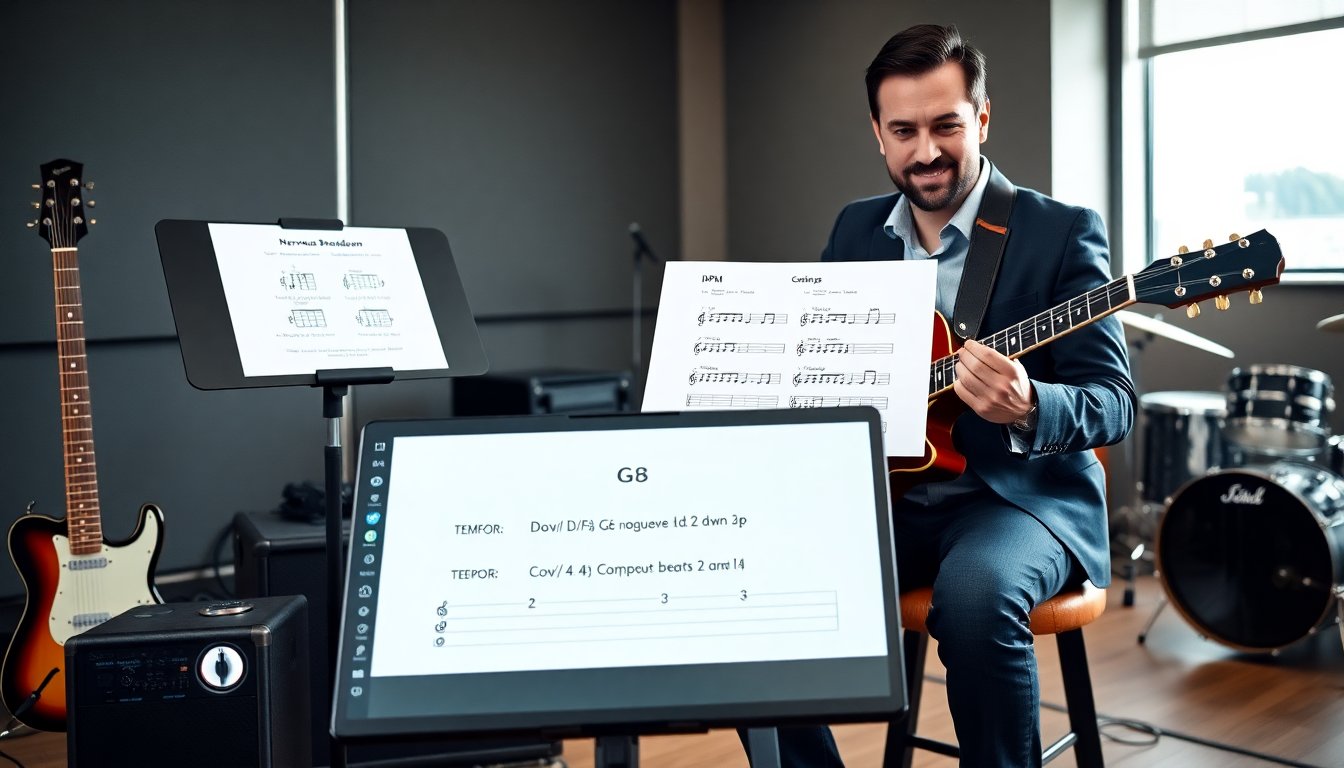
The player will learn 19th nervous breakdown chords and the core shapes needed for the song. The guide will cover key, tempo, main chord voicings, strum feel, and the signature riff. The player will use clear diagrams and concise tabs. The player will read simple tips for singing and playing live. The player will practice short exercises to lock the groove.
Key Takeaways
- Mastering the 19th nervous breakdown chords involves using core G, C, D, and E minor shapes with common bass variations like D/F# and G/B for authentic rhythm parts.
- Maintaining a fast rock feel at 168 BPM with a steady 4/4 pulse and emphasizing beats 2 and 4 in the strumming pattern captures the song’s driving energy.
- Practicing transitions such as G–C–G–D and G–E minor–C–D, along with light palm muting and percussive mutes, helps lock in the groove seamlessly.
- The signature intro riff combines a repeating G–D motif on low strings with walking bass lines and quick hammer-ons, which should be practiced slowly before increasing tempo.
- When playing live, align vocal phrasing with chord accents, simplify guitar parts during busy sections, and coordinate with band dynamics to maintain clarity and tightness.
- Using amp boosts for choruses and carefully timed fills enhance the performance atmosphere and ensure a professional live sound.
Quick Overview Of Song Structure, Key, And Tempo
The song “19th Nervous Breakdown” uses a fast rock feel in the key of G. The player will count a steady 4/4 pulse at about 168 BPM in most studio versions. The structure follows verse–chorus–verse–chorus–bridge–solo–chorus. The player will find the main harmonic movement keeps returning to G, C, and D family shapes with brief use of E and A for passing motion. The player will tune to standard E. The player will listen for a driving snare on beats 2 and 4 to match the original energy.
Core Chords And Common Shapes Used In The Song
The player will use open G, C, D, and E minor shapes for the rhythm parts. The player will add D/F# and G/B as common bass-note variations. The player will use quick changes and short percussive mutes on chord changes. The player will use palm muting lightly for verses and open ringing strums for choruses. The player will match voicings to the vocal melody to keep the texture clear. The player will practice transitions G–C–G–D and G–E minor–C–D to lock the song’s basic loop.
Rhythm, Strumming Patterns, And Groove Tips To Nail The Feel
The player will use a steady down-up pattern with emphasis on beats 2 and 4. The basic strum: down, down-up, down-up with light palm damping on the first down of each bar. The player will add a single muted hit before chord changes to push the groove. The player will play shorter eighths in verses and longer open chords in choruses. The player will use syncopated accents on the offbeats to match the original push. The player will count and tap foot to keep tempo consistent while singing.
Intro Riff, Turnarounds, And Signature Licks — Tab And Breakdown
The intro riff uses a repeating G–D motif on the low strings. Tab (simplified):
e
|—————-|
B
|—————-|
G
|—————-|
D
|—5-5-4-4——|
A
|—5-5-5-5–5-4-|
E
|—3-3-3-3–3-2-|
The player will play the low E root and walk the bass from G to D with quick hammer-ons. The player will add the turnaround: Em–C–G–D with a quick chromatic walk on the low strings. The player will practice the lick slowly, then raise tempo in small steps. The player will keep attack even and timing exact.
Practical Tips For Singing, Arranging, And Playing Live With A Band
The player will match vocal phrasing to chord accents and carve space in the arrangement. The band will keep bass locked to the low root motion and drums will push the backbeat. The player will simplify guitar parts when the lead sings low or during busy sections. The player will add fills on second guitar during choruses and remove fills during verses. The player will use a slight boost in the amp for live choruses and tighten delay for solos. The player will rehearse endings and count-ins to avoid timing mistakes on stage.